Searching for Long Period Comets with Deep Learning at NASA and SETI
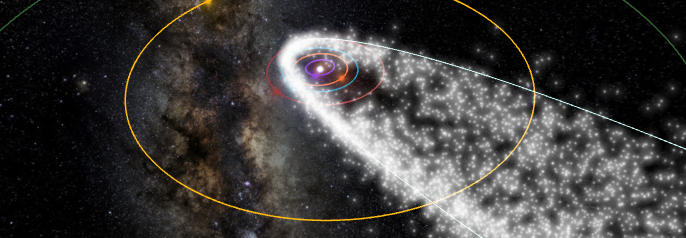
In planetary defence (yes! there is such a thing, where scientists and engineers try to defend the planet from hazards), long-period comets are recognized as the potentially most devastating threat. However, any new comet on an impact trajectory would likely only be discovered about one year before impact. The goal of this project is to add years of extra warning time by providing comet searchers directions on where to look for comets when they are still far out. To aid and guide a dedicated search for these dangerous objects, meteor showers may offer a clue. Comets leave debris trails as they travel along their orbits. When our planet intersects such debris trails, we see them as meteors. By detecting rare aperiodic meteor showers from dust clouds, we can estimate the orbit of the parent body and narrow down the search space where to look for long-period comets.
The Cameras for Allsky Meteor Surveillance or CAMS monitors the sky to detect meteors. Until now, processing the images has required time-consuming human input to rule out false positives. Automating this process allows to free the data analyst in CAMS and enable a global expansion and temporal coverage of the camera network that can detect the dust trails of those potentially hazardous long period comets that came close to Earth’s orbit in the past ten millennia. We developed deep learning tools that allow such automation. Specifically, we developed a Convolutional Neural Network (CNN) that discerns images of meteors vs. other objects in the sky and achieves precision and recall scores of 88.3% and 90.3%, respectively. In addition, we developed a Long-Short Term Memory (LSTM) network that encodes the light curve tracklets into a latent space, and learns to predict whether the tracklet corresponds to a meteor or not. The LSTM achieves a precision of 90.0% and a recall of 89.1%. These methods can now be used by meteor astronomers to automatically analyze sky detections and help guide the search for long-period comets.
Check out our paper
Searching for Long Period Comets with Deep Learning
Workshop on Deep Learning for Physical Sciences (DLPS 2017), NIPS 2017, Long Beach, CA, USA.
Susana Zoghbi, Marcelo De Cicco, Antonio Ordoñez, Andres Plata Stapper, Peter S. Gural, Siddha Ganju, and Peter Jenniskens

You May Also Like

Get the Look on our Chatbot with Visual Search
Leveraging our image and pattern recognition technology, we developed a chatbot that enables users to search product collections using images. Additionally, users can search using both language and images together. For example, I like this item, but I want it with a longer skirt and a V-neck instead of high neck. See it in action here: Your browser does not support the video tag. From the video above, you can see you can perform the following actions: Upload a picture of something you like and …
Transforming the in-store shopping experience with AI
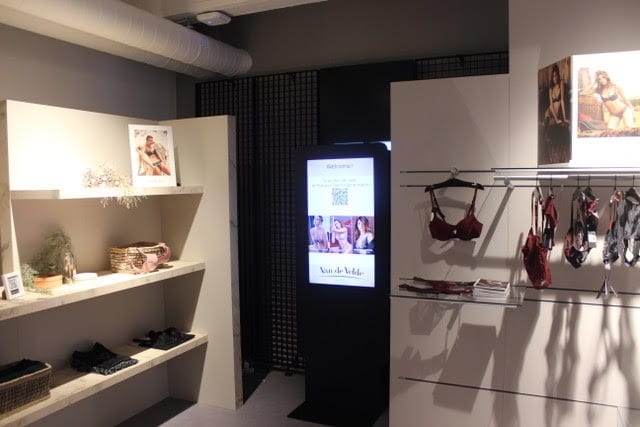
At Macty, we developed a novel in-store experience, where users can upload images of outfits and we suggest lingerie to pair it with. Our ‘Complete the Look’ application inspires customers while helping sellers increase the findability of their products and stimulate sales.” We use advanced image recognition to detect visual attributes from outfits and lingerie to pair them together. Here’s a demo of what this looks like:
Cross-modal Search for Fashion Attributes
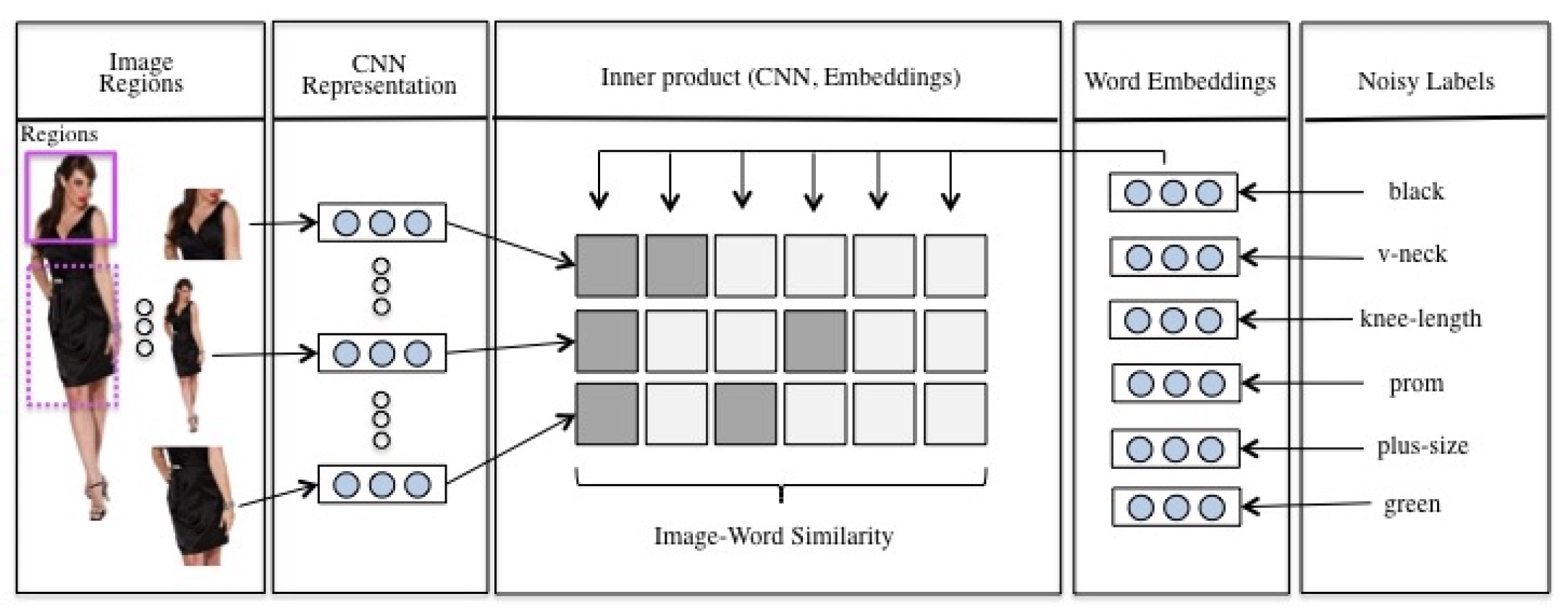
In this paper we develop a neural network which learns inter- modal representations for fashion attributes to be utilized in a cross-modal search tool. Our neural network learns from organic e-commerce data, which is characterized by clean image material, but noisy and incomplete product descrip- tions. First, we experiment with techniques to segment e- commerce images and their product descriptions into respec- tively image and text fragments denoting fashion attributes. Here, we propose a …